


Key Takeaways
- Cleaning gutters once a year is rarely enough, especially in areas with heavy tree coverage or distinct spring and fall seasons.
- Sagging gutters are never "normal." Slope problems escalate into foundation damage and fascia rot faster than most homeowners expect.
- Patching the same gutter section repeatedly often costs more over three to five years than a single replacement would have.
- Gutter guards reduce debris load but do not eliminate cleaning or inspection needs.
- Catching gutter problems early typically keeps repair costs under $300. Ignored problems routinely reach $1,500 to $3,000 or more once structural damage sets in.
Why Gutter Myths Matter to Your Home’s Bottom Line
Gutters are one of the most overlooked systems on any home, and one of the most consequential. They move water away from your foundation, siding, and roof deck. When they fail, water doesn’t just drip over the edge.
It infiltrates fascia boards, saturates soil against your foundation, and backs up under shingles.
A functional gutter system protects your foundation, siding, and roof simultaneously. Small maintenance failures in any one area create a chain reaction of water damage that can cost 10 times more to fix than the original gutter repair.
Gutter problems develop slowly, and that slow pace is exactly what makes myths take hold. Because nothing looks catastrophic today, it’s easy to assume there’s no real urgency. A qualified gutter contractor sees these situations every season and knows that the delay is exactly what drives up the final bill.
At Top Gen Roofing, our work in Residential Roofing and Roof Inspection across New York’s Capital Region shows us the same pattern repeatedly: small gutter problems become large structural repairs when homeowners wait too long.
For more detail, see Get a free estimate.
Myth 1: Gutter Cleaning Once a Year Is Enough
Homeowners who clean their gutters at all usually do it once, late fall, after the leaves drop. That schedule sounds reasonable. What it actually does is leave your gutters clogged for months at a stretch, across two or three full seasons.
How Seasonal Debris Buildup Damages Gutters Faster
Debris doesn’t just sit in your gutters; it holds moisture against the metal or aluminum seams. That constant moisture accelerates corrosion, breaks down sealants at joints and end caps, and adds weight that stresses hangers and spikes. Gutter maintenance professionals identify standing water and organic debris, not age alone, as the primary drivers of premature gutter failure.
In our experience, one heavy rain on a clogged gutter overflows in sheets, and that overflow saturates soil directly against your foundation. In Saratoga Springs, New York, that saturated soil freezes every winter, expands, and over multiple freeze-thaw cycles can crack or shift a foundation.
Why Spring and Fall Require Extra Attention
Spring drops maple seeds, pine pollen, and leftover winter grit into your gutters. Fall brings leaves, seed pods, and twigs from every wind event. Both seasons load debris fast, fast enough to clog a gutter channel within a few weeks. How often gutters should be cleaned depends on your tree coverage, but twice a year is the practical minimum for most homes.
Myth 2: A Little Sagging Is Normal and Can Wait
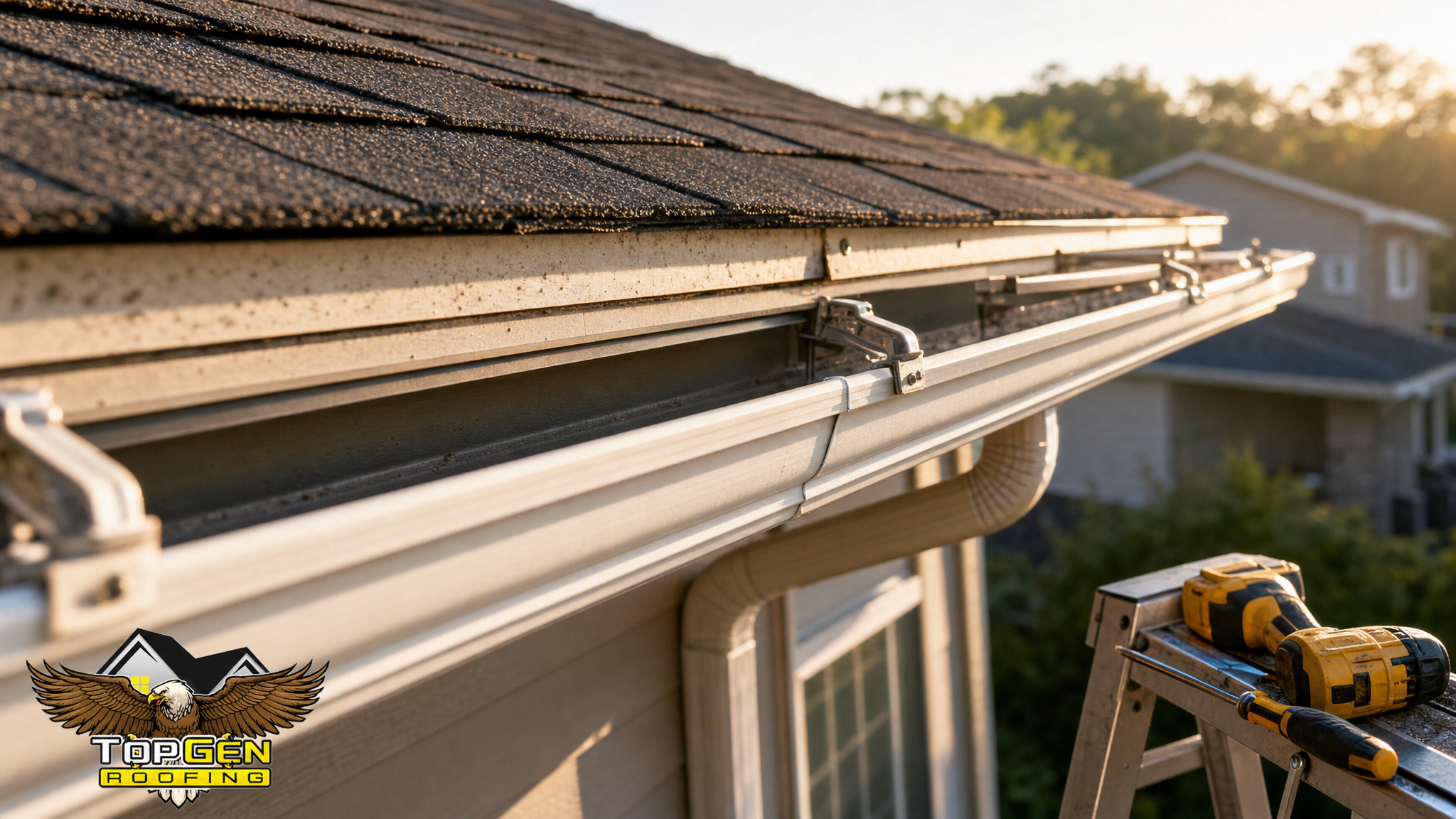
Gutters sag when hangers loosen, spikes pull out of the fascia, or accumulated weight bends the channel. The sag looks minor. Most homeowners figure it can wait until next year.
That call gets expensive.
The Domino Effect of Ignoring Slope Problems
A properly hung gutter slopes toward its downspout at one quarter inch of drop per ten feet of run. That pitch is what keeps water moving. Where a section sags, water pools in the low spot instead of draining out, and that standing water accelerates every failure mode: corrosion, joint separation, and overflow.
A pooling section also adds load to the hangers on either side. One or two seasons later, those neighboring hangers start pulling out too. A $75 hanger replacement turns into a full section re-hang or a complete gutter replacement.
Water Damage, Foundation Issues, and Fascia Rot
Overflow from a sagging gutter runs straight down the fascia board behind the gutter. Fascia rot is quiet and fast. By the time you see peeling paint or feel soft wood, the rot has already worked several inches into the board, and sometimes into the rafter tails behind it.
Depending on how much linear footage is affected, repairing rotted fascia and rafter tails can run $500 to $1,500, and that’s before anyone touches the gutters. The real cost of neglected gutter repairs climbs fast once structural wood is involved. Catch a sagging section before the fascia is compromised and the whole job stays simple.
Myth 3: You Can Patch Gutters Indefinitely Instead of Replacing Them
Gutter sealant and patch tape are legitimate repair tools for isolated cracks or pinhole leaks on an otherwise sound gutter. The problem is when homeowners apply patch after patch to a gutter that has fundamentally failed. At some point, the patches cost more than the replacement would have.
When Temporary Fixes Become False Economy
Each patch holds for a season or two, then fails at a slightly different spot. You call a contractor again, pay another bill, and meanwhile the underlying gutter is corroded, out of slope, and putting stress on the surrounding structure. You’re spending $150 to $300 per visit on a system that needs Roof Repair or replacement-level attention, not another patch.
We’ve seen homeowners spend more on repeated patchwork over three years than a full Roof Replacement of their gutter system would have cost upfront. A straight-talking gutter contractor will tell you when a gutter has passed the point of cost-effective repair. If corrosion, joint separation, or repeated leak sites affect more than 30 to 40 percent of a gutter run, replacement is the smarter financial call.
Repair vs. Replace: A Cost Comparison Timeline
| Scenario | Typical Cost (Approx.) | Long-Term Outcome |
|---|---|---|
| Single patch repair, isolated crack | $100, $200 | Cost-effective if gutter is otherwise sound |
| Two to three patches over two years | $300, $600 cumulative | Break-even territory; inspect for replacement |
| Repeated patches on failing gutter | $600, $1,000+ cumulative | Replacement would have cost less |
| Full gutter section replacement | $400, $900 per section | Resolves problem; 20+ year lifespan typical |
| Full gutter system replacement | $1,200, $2,500 for average home | Best long-term value when system is failing |
If your gutter has needed more than one repair in 24 months, ask your contractor for an honest assessment of the full system. Our gutter repair service includes a condition assessment so you know exactly what you’re working with before spending another dollar on patches.
Myth 4: Gutter Guards Eliminate the Need for Maintenance
Gutter guards are a worthwhile investment for many homes. They cut cleaning frequency and block large debris from entering the channel. But "eliminate" is where the myth starts.
No guard system removes the need for periodic inspection and cleaning entirely.
Common Guard Failures and Hidden Debris Pathways
Micro-mesh guards are the most effective type currently available, and they still accumulate shingle grit, pollen, and fine organic matter on the mesh surface. That buildup slows water flow and can trigger overflow during a hard rain. Industry guidance on gutter maintenance is consistent: guards work best as part of a maintenance plan, not as a substitute for one.
Foam and brush-style guards are particularly prone to holding debris inside the guard material, sometimes making cleaning more difficult than an open gutter would be. Seeds also germinate inside guards, and the resulting plant growth can damage both the guard and the gutter channel beneath it.
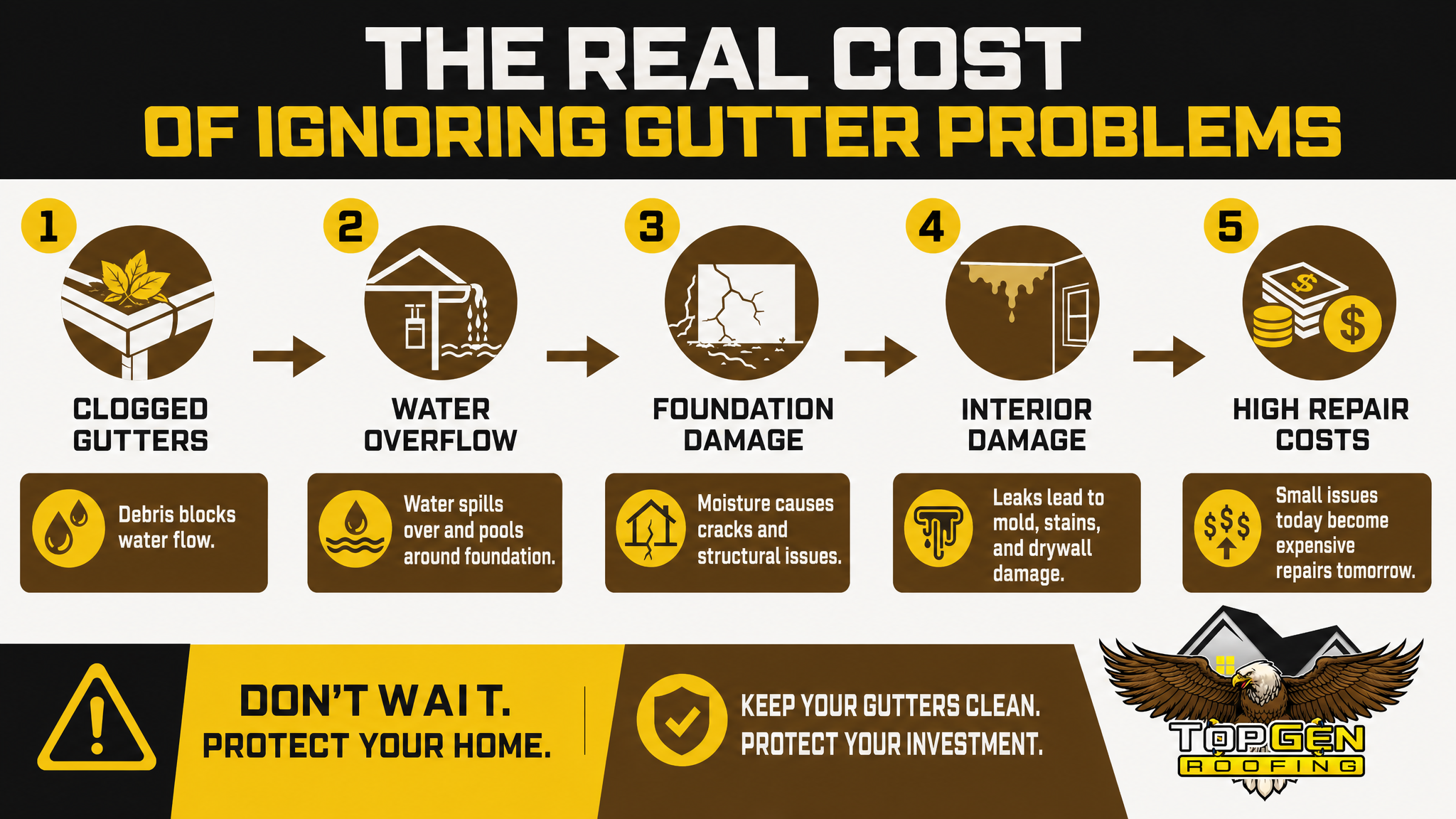
The Real Cost of Ignoring Gutter Problems
Most articles on this topic stay vague here. Below are the actual downstream costs that follow ignored gutter problems.
Escalating Repair Costs and Property Damage
| Ignored Problem | Downstream Damage | Estimated Repair Range |
|---|---|---|
| Clogged gutter, one season | Fascia staining, minor siding damage | $200, $500 |
| Clogged gutter, two or more seasons | Fascia rot, soffit damage | $500, $1,500 |
| Sagging gutter, ignored | Fascia and rafter tail rot | $800, $2,000 |
| Persistent gutter overflow | Foundation water infiltration | $2,000, $10,000+ |
| Backed-up gutters in winter | Ice dams, shingle and roof deck damage | $1,500, $5,000 |
The pattern holds across every scenario: early action costs a fraction of the structural repair bill. A professional gutter installation or a timely replacement on a failing system protects your foundation, roof deck, and siding all at once. When working with clients on Storm Damage Roofing claims, we frequently find that gutter failure was the first domino, allowing water to reach the roof deck and fascia before any storm event caused visible damage.
Sagging gutters, overflow during rain, visible rust, or paint peeling below the gutter line are not cosmetic problems. Each one signals that water is going somewhere it shouldn’t. If you’re searching for residential gutter repair near me, prioritize contractors who assess the full drainage system, not just the visible crack or sag.
Frequently Asked Questions
How often should gutters be cleaned?
Most homes need gutter cleaning at least twice a year, late spring and late fall. Homes with heavy canopy coverage from pines, maples, or similar trees need three to four cleanings annually. One cleaning a year leaves gutters clogged through the wettest months, which is exactly when overflow damage hits.
If you’re not sure what schedule fits your property, our guide on how often you should clean your gutters breaks it down by home type and tree coverage.
What are the most common signs you need gutter repair?
The clearest signs you need gutter repair: water overflowing the sides of gutters during rain, visible sagging or sections pulling away from the fascia, rust streaks or orange staining on the gutter surface, peeling paint on siding directly below the gutter line, and water pooling near your foundation after rain. Any one of those signals that your gutter system is no longer moving water correctly. Don’t wait for multiple symptoms before calling a gutter contractor.
Is it worth hiring a professional gutter contractor or can I handle repairs myself?
Minor cleaning is a reasonable DIY task if you’re comfortable on a ladder. Repairs, re-sloping, re-hanging sections, and replacement work are different. Improperly pitched gutters, over-driven spikes, and incorrectly sealed joints are the most common reasons DIY gutter repairs fail within a season.
A professional gutter contractor has the tools to set correct slope, seal joints permanently, and identify underlying fascia or soffit damage you might miss from the ground. For anything beyond debris removal, professional work pays for itself in durability. Our Residential Roofing and Commercial Roofing teams extend that same assessment to every drainage system we inspect.
How long do gutters typically last?
Aluminum gutters, the standard choice on residential homes across the northeastern United States, last 20 to 30 years with consistent maintenance. Galvanized steel runs closer to 15 to 20 years before rust becomes a recurring issue. Copper can hold up 50 years or more, but the installation cost reflects that lifespan.
Neglected gutters of any material can fail in 10 years or less due to corrosion from standing debris and water. Consistent cleaning and prompt repairs are the single biggest factor in reaching the upper end of any gutter’s expected lifespan. Our Roof Installation work regularly includes new gutter runs, and we always document baseline condition so clients have a reference point for future Roof Repair decisions.
When should I replace gutters instead of repairing them?
Replace rather than repair when you see widespread corrosion across multiple sections, when the same sections have needed repairs more than once in two years, when seams are separating along most of the run, or when gutters are pulling away from the fascia along significant lengths. A qualified contractor can assess whether a gutter replacement beats continued patching on your specific system. On a home with failing gutters, full replacement typically pays back its cost within a few years by cutting off the downstream damage before it compounds.
Do seamless gutters require less maintenance than sectional gutters?
Yes, meaningfully so. Seamless gutters have no joints along the run except at corners and downspout connections. Joints are where sectional gutters most commonly leak, separate, and trap debris. Eliminate the joints, and you eliminate the most common failure points.
You still need to clean them and inspect end caps and downspout connections periodically, but the overall maintenance burden is lower. If you’re replacing a failing sectional system, the modest upfront difference for seamless gutters is worth it.
 FREE estimate within 24 hours Share a few details with Top Gen Roofing, we’ll help you choose the right next step. Get a free estimate |