

Key Takeaways
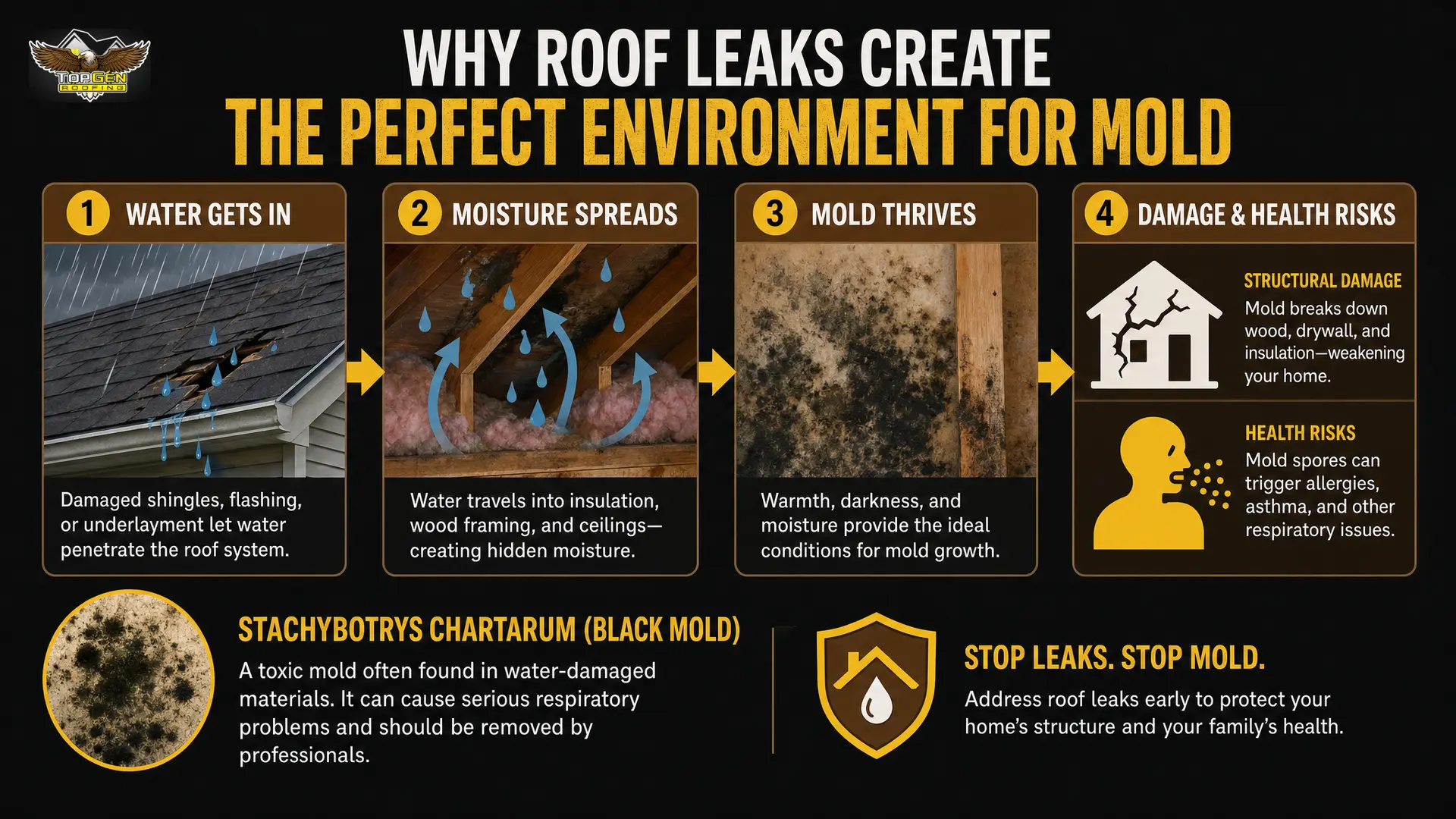
- Mold growth can start within 24 to 48 hours of water intrusion from a roof leak.
- Common household mold species like Cladosporium and Stachybotrys (black mold) thrive in damp attic spaces with poor airflow.
- Prolonged roof leaks weaken load-bearing rafters and roof sheathing, creating structural failure risk within weeks.
- Early warning signs include water stains, musty odors, sagging drywall, and higher energy bills.
- Professional roof repair combined with mold remediation is the safest path to protecting your home and family.
Why Roof Leaks Create the Perfect Environment for Mold
Mold needs three things to grow: moisture, an organic food source, and temperatures between roughly 40°F and 100°F. A leaking roof delivers all three directly into the hidden spaces of your home where air circulation is poorest.
Your attic and wall cavities are dark, relatively warm, and full of wood, insulation, and drywall, all organic materials that fungal growth consumes in the $2,500, $6,000 range for mid-size projects. A single breach in your roofing system turns that environment into an incubator, with roughly 60, 70% of homeowners reporting similar outcomes.
Moisture, warmth, and darkness accelerate mold colonization
Once water enters through a damaged shingle, flashing failure, or cracked sealant, it soaks into wood framing and insulation within minutes between 2023 and 2025 across most markets. The enclosed space traps humidity, and attic temperatures can easily climb above 90°F during warmer months, a figure that rose roughly 12% year over year in recent studies. That combination of sustained moisture and warmth is exactly what airborne fungal particles need to germinate and spread, often cited in the .,800, $4,200 range depending on scope.
Attics with poor ventilation are especially vulnerable. Stagnant, humid air gives colonies no reason to stop growing. According to research on how roof leaks lead to mold growth, even minor recurring leaks can saturate insulation enough to sustain mold colonies long after the rain stops.
How quickly mold spreads in attics and wall cavities
Speed is what catches most homeowners off guard. Fungal particles are always present in the air; they just need moisture to activate, with about 55, 65% of projects completed within 30 days. Within 24 to 48 hours of water intrusion, germination begins on wet drywall, plywood sheathing, and fiberglass or cellulose insulation, typically representing 15, 25% of overall project budgets.
Visible surface mold typically appears within one to two weeks. Wall cavities make the problem worse because you cannot see inside them, according to common industry estimates from 2024. By the time discoloration appears on your drywall surface, there is often a much larger colony growing behind it.
This is why a professional roof inspection after any leak, even a small one, matters far more than most homeowners realize.
Common mold species found after roof leaks
Not all mold is equally dangerous, but none of it belongs inside your home. The species most commonly found after roof leaks include:
| Mold Species | Color/Appearance | Common Location | Risk Level |
|---|---|---|---|
| Cladosporium | Olive green or brown | Attic wood, ceiling tiles | Moderate |
| Penicillium | Blue-green, powdery | Insulation, drywall | Moderate to High |
| Aspergillus | White, yellow, or green | Walls, HVAC ducts | High |
| Stachybotrys (black mold) | Dark green/black, slimy | Chronically wet wood | Very High |
Stachybotrys chartarum, commonly called black mold, is the most concerning. It typically appears only after prolonged moisture exposure, which is one reason addressing leaks early matters so much: you prevent the conditions that allow the most toxic species to take hold.
Health Risks from Mold Exposure in Water-Damaged Homes
Mold exposure from roof leaks is a genuine health risk, not a cosmetic nuisance. Airborne particles released into your living space can cause respiratory problems, skin irritation, and serious complications in people with compromised immune systems.
Respiratory problems and allergic reactions
The most common complaint from homeowners dealing with mold exposure is respiratory: persistent coughing, nasal congestion, throat irritation, and wheezing.
Skin rashes and eye irritation are also frequent.
Vulnerable populations: children, elderly, immunocompromised
Healthy adults can usually tolerate low levels of mold exposure without severe effects.
As noted by mold and health risk research from roof leak specialists, people with asthma are particularly susceptible to airborne fungal particles, which can cause acute attacks even at exposure levels that produce no symptoms in healthy adults.
Long-term health effects of prolonged mold exposure
Short-term exposure causes acute symptoms.
The structural repairs also become dramatically more expensive the longer the problem goes unresolved.
Structural Damage Timeline: From Leak to Rot
A roof leak does not damage your home all at once. It works in stages, and each stage costs more to fix than the one before it.
Week one: water saturation of wood framing and insulation
In the first week, water saturates the materials it contacts directly: roof sheathing (typically OSB or plywood), rafters, and insulation batts.
This is the window where quick action, stopping the leak, extracting standing water, and drying the space, can prevent the most expensive damage.
Weeks two to four: fungal decay and load-bearing weakness
By week two, fungal rot takes hold in wood that has not dried.
In our experience with Residential Roofing projects across upstate New York, a rafter or sheathing panel that looked intact from below by week four may have already lost significant structural integrity.
Month two onward: compromised roof integrity and foundation threats
A leak running for two months or longer does not stay confined to the attic.
At this stage, you may face sheathing replacement, rafter sistering, insulation removal, mold remediation, and drywall demolition, easily three to five times the cost of early intervention.
Early Warning Signs of Roof Leaks and Moisture Damage
Catching a roof leak early is always cheaper than treating the downstream damage.
Water stains, discoloration, and soft spots in ceilings and attics
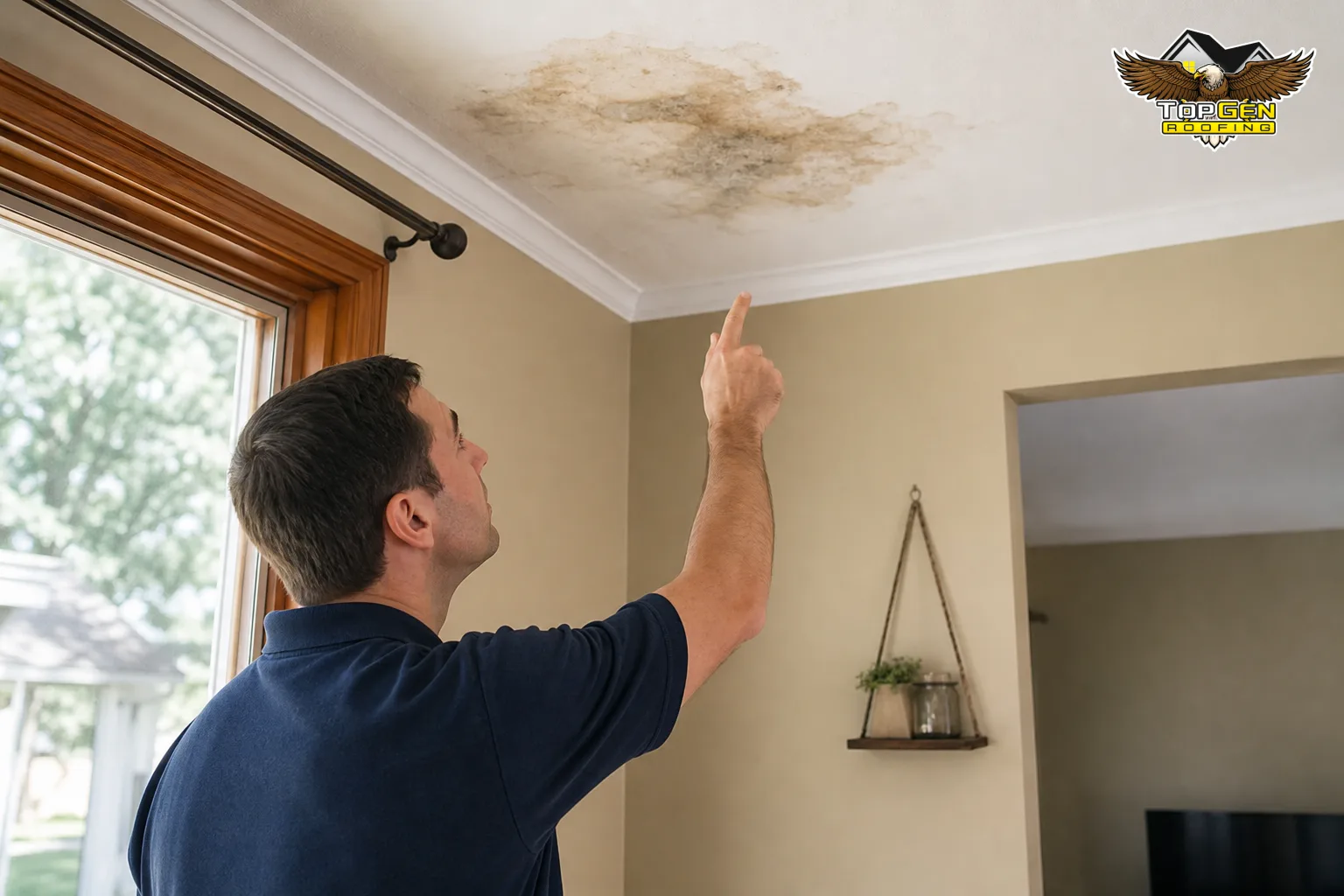
Brown or yellow rings on your ceiling are the most obvious sign.
Inside the attic, look for dark staining on rafters and sheathing, and any insulation that appears flattened, discolored, or feels damp.
Musty odors and visible mold growth on rafters and sheathing
A persistent musty or earthy smell in your attic, upper floors, or closets near exterior walls is a reliable indicator of hidden mold.
According to guidance on attic mold caused by roof leaks, attic mold is frequently discovered during routine inspections rather than by the homeowner, simply because most people do not check their attic after every storm.
Sagging drywall, peeling paint, and increased energy bills
Drywall that bulges or sags is holding water.
All three signals point to the same source, moisture that found a way in through your roof.
Emergency roof repair and water extraction steps
Your first priority is stopping new water from entering.
Once the entry point is controlled, extract standing water from the attic or affected rooms as quickly as possible.
Professional mold remediation and structural assessment
If you suspect mold has already started, skip the DIY bleach treatment.
We’ve seen homeowners attempt surface-only treatments only to find the colony fully re-established within weeks, because the moisture source and embedded growth were never properly addressed.
Alongside remediation, a structural assessment from a qualified contractor identifies which rafters, sheathing panels, or wall framing members have been compromised.
Long-term prevention: inspections, maintenance, and ventilation
Fixing the immediate damage is only part of the solution.
- Annual or biannual roof inspections to catch cracked shingles, failing flashing, and deteriorating sealant before they become leaks.
- Proper attic ventilation to keep humidity levels low year-round. Ridge vents, soffit vents, and powered attic fans each play a role in maintaining airflow that discourages mold growth.
- Gutter maintenance to ensure water is directed away from your roofline and foundation rather than backing up under shingles. Clogged gutters are a leading cause of edge-related leaks, particularly during the freeze-thaw cycles common in upstate New York.
For flat or low-slope Commercial Roofing systems, the prevention calculus is slightly different.
You can review the roofing process overview to understand what a thorough assessment should include.
When to Call a Professional and What to Expect
Some situations call for a phone call before you even set foot in the attic.
Red flags that require immediate roof repair and mold testing
Call a professional the same day if you observe any of the following:
| Warning Sign | Likely Cause | Urgency |
|---|---|---|
| Active dripping during or after rain | Shingle failure or flashing breach | Immediate |
| Sagging ceiling or bulging drywall | Water accumulation above ceiling | Immediate |
| Visible black or dark green mold on rafters | Prolonged moisture, likely 2+ weeks | Same day |
| Strong musty odor throughout upper floor | Established mold colony in wall cavities | Same day |
| Spike in energy bills with no other explanation | Wet, compressed, or missing insulation | Within the week |
| Daylight visible in attic | Open penetration in roof deck | Immediate |
Any combination of these signs warrants both a roof inspection and a mold assessment, not just one or the other.
Choosing certified contractors and remediation specialists
For the Roof Installation or Roof Replacement work, choose a licensed contractor who carries liability insurance and can provide a written scope of work before any repairs begin.
When working with clients in the Capital Region, we always include a sheathing and rafter check as a standard part of the initial assessment, because surface-only evaluations routinely miss rot that is already affecting structural capacity.

For mold remediation, look for professionals certified by the Institute of Inspection, Cleaning and Restoration Certification (IICRC) or a comparable credentialing body.
Homeowners sometimes ask whether a home warranty covers roof leaks and the resulting mold damage.
Review your policy and contact your insurer before beginning any remediation work to understand what documentation they require.
Storm Damage Roofing claims follow a similar path: document everything with photographs before repairs begin, and request a written estimate that separates structural work from cosmetic repairs to simplify the claims process.
For metal roofs specifically, how to stop leaks on a metal roof often comes down to failed sealant around penetrations, loose fasteners, or compromised seam tape.
You can also review essential roof repair guidance to understand what a thorough inspection should cover before authorizing any work.
The comprehensive overview of roof leaks, ceiling water damage, and mold growth reinforces that early professional intervention consistently produces better outcomes than delayed action, both in total remediation cost and in long-term structural integrity.
If you are a commercial property owner, the stakes are higher still.
Frequently Asked Questions
How fast do roof leaks cause mold growth?
Fungal germination on wet building materials can begin within 24 to 48 hours of water exposure.
Attics with wood framing and cellulose insulation are among the fastest environments for mold to establish. In warm, humid conditions typical of spring and summer, mold colonies can become visible within a week. Winter delays growth but does not stop it, dormant spores simply wait for warmer temperatures to activate.
The longer water sits in your attic or walls, the deeper mold penetrates into structural materials, making removal exponentially more difficult and expensive.
This is why prompt roof repair matters so much. A small leak that goes unnoticed for two weeks can transform a straightforward repair into a full remediation project costing thousands of dollars.
Can I remove mold from roof leaks myself?
Surface mold on non-porous materials can sometimes be cleaned with appropriate products, but growth inside wood, drywall, or insulation requires professional remediation. Disturbing mold colonies releases spores into the air, which can spread contamination to other areas of your home and pose respiratory risks. If you suspect mold has penetrated structural materials, do not attempt DIY removal.
A certified mold remediation contractor will contain the affected area, use proper ventilation and protective equipment, and dispose of contaminated materials safely. The cost of professional remediation typically ranges from $2,000 to $6,000 depending on the extent of growth, but it prevents costly structural repairs and protects your family’s health.
Does homeowner’s insurance cover mold from roof leaks?
Coverage varies by policy and the cause of the leak.
Contact your insurer early and document all damage with photographs before any repairs begin. Take pictures of wet insulation, stained wood, visible mold, and any ceiling or wall damage from multiple angles. Keep receipts for emergency tarping or temporary fixes, as insurers often cover mitigation costs.
Report the leak promptly, most policies require notification within a specific timeframe to qualify for coverage. Ask your adjuster directly whether does a home warranty cover roof leaks under your specific plan, since coverage depends on the leak’s cause (manufacturing defect, age, storm damage, or neglect) and your policy terms. Document the date you discovered the leak and any prior maintenance records, as this timeline affects claim approval.
How do I know if my roof is leaking if there are no visible stains?
Not all roof leaks produce immediate ceiling stains. Water can travel along rafters, drip into wall cavities, or pool in attic insulation before you notice any damage below. Check your attic after heavy rain, especially in corners where roof planes meet and along the eaves.
Look for wet wood, discolored insulation, or soft spots in the decking. If you spot moisture but no obvious hole, the leak may be coming from flashing around vents, chimneys, or skylights, areas where water can seep sideways before dripping down. A roof inspection by a professional can pinpoint hidden leaks using moisture meters and thermal imaging, catching problems before they spread to living spaces.
What is the cost difference between early and late roof leak repair?
Addressing a roof leak early, patching damaged shingles, resealing flashing, and drying the attic, typically costs a few hundred dollars. Waiting weeks or months transforms that into thousands. A small shingle repair might run $200 to $500.
The same leak left untreated can demand a full roof replacement costing $8,000 to $15,000 or more, plus structural repairs to rotted decking, mold remediation, and drywall replacement inside your home. Insurance may cover storm damage, but it rarely covers neglect. The longer water sits in your attic, the faster decay spreads.
How do roof leaks affect indoor air quality?
Active mold growth from a roof leak releases airborne particles and, in some cases, mycotoxins into your home’s air. These spores circulate through your HVAC system and settle on surfaces, triggering respiratory issues, allergies, and asthma flare-ups, especially in children, elderly residents, and anyone with compromised immunity. You may notice musty odors in bedrooms or living spaces weeks before visible mold appears on walls or ceilings.
By then, the contamination has already spread behind drywall and into insulation, making remediation far more expensive and invasive than catching the leak early.
 FREE estimate within 24 hours Share a few details with Top Gen Roofing, we’ll help you choose the right next step. Get a free estimate |