


Key Takeaways
- Multiple financing options exist for roof replacement, from personal loans to contractor payment plans, each with different cost and credit requirements.
- Applying with bad credit is still possible through specific lenders and programs, but terms will vary significantly.
- Retailer financing (like Home Depot roof replacement financing) covers materials only and often excludes labor.
- Your credit score, loan term, and interest rate together determine the true cost of financing, not just the monthly payment.
- Getting a free estimate first gives you the exact number you need before comparing loan offers.
Why Financing Options Matters Now
Roof replacement is a non-negotiable repair for most homeowners. How you fund it determines your total cost as much as the contractor you choose.
The roofing market in 2026 looks different than it did just three years ago. Material costs have stabilized somewhat after the supply disruptions of earlier years, but labor costs in upstate New York remain elevated. Waiting too long on a failing roof rarely saves money.
Relevant expertise includes Roof Installation, Residential Roofing, Commercial Roofing, Roof Inspection, Shingle Roofing, Project Estimation.
Water intrusion leads to deck rot, attic mold, and insulation damage that multiplies the original repair bill fast.
What Has Changed Recently
Interest rates on personal loans and home equity products shifted meaningfully through 2023 and 2024. Many homeowners who expected to refinance or tap equity inexpensively found those routes more expensive than anticipated. At the same time, several roofing manufacturers and financing partners have expanded contractor-arranged financing programs, giving homeowners more direct access to competitive loan products right at the point of estimate.
The financing options landscape now includes buy-now-pay-later style products for home improvement, FHA Title I loans for property improvements, state energy efficiency programs tied to certain roofing upgrades, and traditional personal loans from credit unions and online lenders. Knowing which category fits your credit profile and timeline is the starting point.
What Readers Need to Understand First
Your credit score, debt-to-income ratio, and available home equity are the three variables that determine which doors open. You do not need perfect credit to finance a roof, but your options narrow and your interest rate climbs as your score drops. If you are researching roof replacement financing near me, the contractor you hire may offer in-house financing or a referral to a preferred lender, which can simplify the process considerably.
Before signing anything, understand the difference between promotional deferred interest and true zero-percent financing. Deferred interest means that if you carry any balance past the promotional period, the full accumulated interest charges back to day one. True zero-percent financing charges no interest at all during the term.
The language matters.
Common Financing Options Mistakes to Avoid
Homeowners lose real money on financing errors that are entirely preventable. These two mistakes show up more often than any others.
Mistake 1 and How It Hurts Results
Focusing only on the monthly payment instead of the total cost is the single most expensive financing mistake. A contractor or lender who quotes you a low monthly number may be spreading a high-interest loan over 10 to 15 years. A $12,000 roof financed at 18% APR over 10 years costs roughly $21,700 total.
That same roof financed at 7% over 5 years costs about $14,300. The monthly payment on the longer loan looks smaller, but you pay nearly $7,400 more.
Always ask for the APR, the loan term, and the total repayment amount in writing before you agree to anything.
Mistake 2 and How to Spot It Early
Choosing Home Depot roof replacement financing or similar retailer credit for a complete roof replacement without reading the scope limitations is a common trap. Retailer financing programs are designed for material purchases. If your contractor is sourcing materials independently, retailer credit likely does not apply to labor, tear-off, or disposal, which can represent 40 to 60 percent of the total project cost.
Spot this early by asking one direct question: Does this financing cover the full installed cost, including labor, tear-off, and cleanup?
How to Fix Each Mistake Quickly
Request an itemized written estimate from your roofing contractor first. Check out our detailed look at roof replacement costs in the Albany area to understand what a realistic project total looks like before you talk to any lender.
Once you have a firm number, use an online loan calculator to compare at least three offers side by side. Enter the APR, not the interest rate, and use the same loan term for each comparison. The lender with the lowest APR on a term you can comfortably service wins.
Practical Financing Options Improvements

Getting financing right is a process, not a single decision. A structured approach saves you time and money.
Audit Your Current Approach
Next, calculate your available home equity. Subtract your mortgage balance from your home’s current market value. If you have at least 15 to 20 percent equity, a home equity line of credit (HELOC) or home equity loan becomes a viable option with typically lower rates than unsecured personal loans.
Implement the Highest-Impact Fixes
If your credit score is under 620, you are in the territory that most conventional lenders classify as roof replacement financing bad credit. Options still exist, including FHA Title I home improvement loans, which do not require equity and have more flexible credit standards. Some roofing contractors also partner with specialty lenders that serve this segment.
The FHA Title I Loan program through HUD is worth reviewing if equity-based financing is off the table.
Credit unions frequently offer personal loan rates lower than traditional banks, especially for members in good standing. If you belong to one, call them before applying anywhere else.
Track and Refine Over Time
Once your financing is in place, set up autopay immediately. Most lenders offer a 0.25% rate reduction for automatic payment enrollment. Track your balance against the amortization schedule quarterly.
If your financial situation improves, a partial prepayment can significantly cut total interest, especially in the first half of a long loan term.
Tools, Examples, and Proof Points
Recommended Tools or Workflows
Your roofing contractor’s estimate is itself a tool. A detailed, written estimate from a licensed contractor is required by most lenders as part of the application. Make sure it includes line items for materials, labor, tear-off, disposal, and any code-required upgrades.
Real-World Examples
A homeowner in Saratoga Springs facing a storm-damaged roof on a 2,200 square foot colonial had three paths: a HELOC at 8.5% variable, a personal loan at 11.9% fixed for 5 years, and a contractor-arranged financing plan at 9.9% fixed for 7 years. The HELOC carried the lowest rate but variable risk. The personal loan had the highest payment but the lowest total cost.
The contractor plan split the difference on both.
For a homeowner with stable income and good credit, the personal loan won on total cost. For one with tighter monthly cash flow, the 7-year contractor plan made sense even at a slightly higher rate. Neither answer is universal.
That is why comparing total repayment figures, not just monthly amounts, is the only honest benchmark.
Comparison and Decision Guide
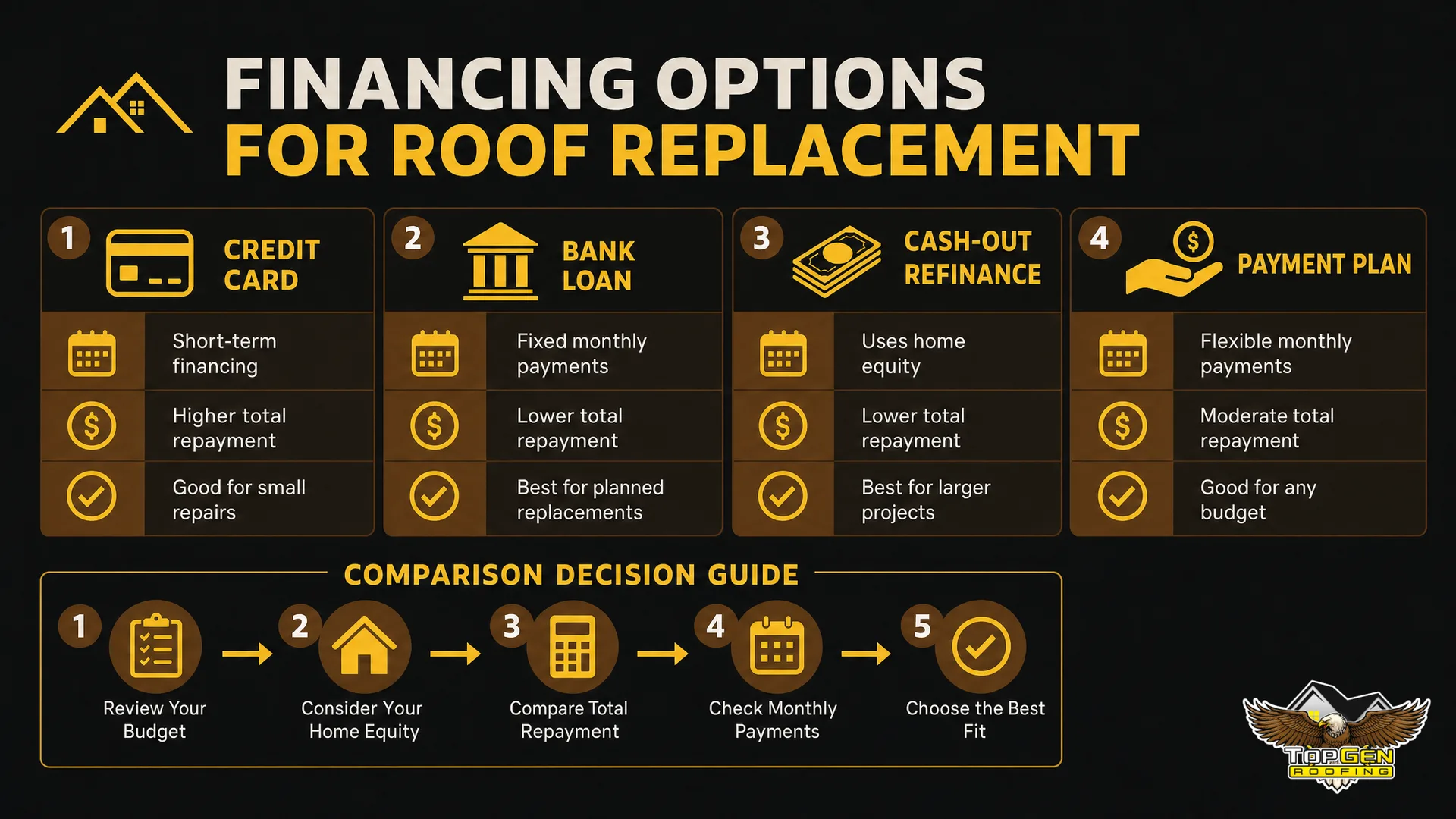
When to Choose Each Approach
| Financing Type | Credit Needed | Covers Full Project | Typical APR Range | Best For |
|---|---|---|---|---|
| Personal Loan | 620+ preferred | Yes | 7%, 25% | Good credit, fast approval |
| HELOC / Home Equity Loan | 640+ with equity | Yes | 7%, 12% variable/fixed | Homeowners with significant equity |
| Contractor-Arranged Financing | 580+ (varies) | Yes (all-in) | 9%, 18% | Convenience, one-stop process |
| FHA Title I Loan | Flexible (no equity req.) | Yes | Varies by lender | Low equity or lower credit scores |
| Retailer Credit (Home Depot etc.) | 640+ | Materials only | 0%, 29.99% (deferred risk) | Material purchases, short-term payoff |
Cost, Effort, and Timeline Tradeoffs
Speed matters after storm damage. Personal loans and contractor-arranged financing can fund in 24 to 72 hours. HELOC approval typically takes two to four weeks.
FHA Title I loans require HUD-approved lenders and more documentation, adding another week or two to the process.
Conclusion and Next Steps
Main Points to Remember
Financing options for roof replacement range from personal loans to government-backed programs, and none of them is right for every homeowner. Your credit score, equity position, monthly cash flow, and timeline determine the best fit. The total repayment amount, not the monthly payment, is the honest metric for comparison.
And retailer financing covers materials only, which makes it a poor match for a full roof replacement without careful reading of the terms.
If you have any questions about what a replacement actually involves before you start comparing loans, our guide on what to expect from a roof replacement walks you through the process step by step.
What to Do Next
Start with a free, itemized estimate. You cannot compare loan offers meaningfully without knowing the exact project cost. Once you have that number, pull three loan offers using your actual APR, enter them into a loan calculator with the same term, and pick the one with the lowest total repayment you can afford monthly.
Top Gen Roofing serves homeowners across Saratoga Springsand the surrounding Capital Region. Request your FREE estimate within 24 hours and get a clear, itemized project total you can take directly to any lender or financing program.
You can also check out our current $500 off roof replacement offer to reduce your out-of-pocket total before financing even enters the picture.
Frequently Asked Questions
What credit score do I need to finance a roof replacement?
Most personal loan lenders prefer a score of 620 or higher, though some contractor-arranged programs work with scores as low as 580. Home equity products generally require at least 640 and meaningful equity in the property. If your score is below 580, FHA Title I loans through HUD-approved lenders are often the most accessible path.
Checking your credit report for errors before applying can sometimes improve your score enough to qualify for a better tier.
Is roof replacement financing bad credit still possible?
Yes. Roof replacement financing bad credit options exist, but you should expect higher interest rates and shorter maximum loan terms. FHA Title I loans do not require home equity and carry more flexible underwriting than conventional personal loans. Some specialty lenders work directly with roofing contractors to serve this segment.
Regardless of your credit profile, getting multiple quotes matters more when rates are higher because the spread between lenders widens considerably.
Does Home Depot roof replacement financing cover the full project cost?
Home Depot roof replacement financing applies to materials purchased through their store or affiliated contractors. It does not automatically cover labor, tear-off, debris disposal, or code upgrades, which together can represent 40 to 60 percent of your total project cost. If your contractor sources materials independently, retailer credit may not apply at all.
Always confirm in writing what the financing covers before relying on it for a complete replacement.
How long does it take to get approved for roof financing?
Approval timelines vary by product. Personal loans through online lenders can approve and fund in 24 to 48 hours. Contractor-arranged financing programs often deliver same-day or next-day decisions.
Home equity loans and HELOCs typically take two to four weeks due to appraisal and underwriting requirements. FHA Title I loans add another one to two weeks on top of that.
Should I use a HELOC or a personal loan for roof replacement?
The right choice depends on your equity position and risk tolerance.
If you have substantial equity and plan to pay off the balance within a few years, a HELOC often wins on total cost.
Can I finance a roof replacement and gutter work at the same time?
Many lenders allow you to bundle related exterior repairs into a single loan as long as the total amount falls within their limits.
You can learn more about what a full exterior upgrade involves on our gutter replacement services page.
Top Gen Roofing serves homeowners across Saratoga Springs, New York and the surrounding Capital Region with honest estimates, quality workmanship, and straightforward answers on every financing question you have.
 FREE estimate within 24 hours Share a few details with Top Gen Roofing, we’ll help you choose the right next step. Get a free estimate |