


Key Takeaways
- Document everything before you clean up: photos, video, weather records, and a written damage log.
- Most homeowners insurance policies require you to report wind damage within 30 to 365 days of the event, depending on your state and carrier.
- A professional roof inspection report from a licensed contractor carries far more weight with adjusters than DIY photos alone.
- Pre-existing wear and deferred maintenance are the two most common reasons wind damage roof claims get denied.
- Appealing a denied claim is your right, and hiring a public adjuster or attorney can shift the outcome significantly.
Assess and Secure Your Roof Immediately After Wind Damage
The first 24 to 48 hours after a wind event are the most critical. Acting fast protects your home from secondary water damage and strengthens your claim before evidence degrades.
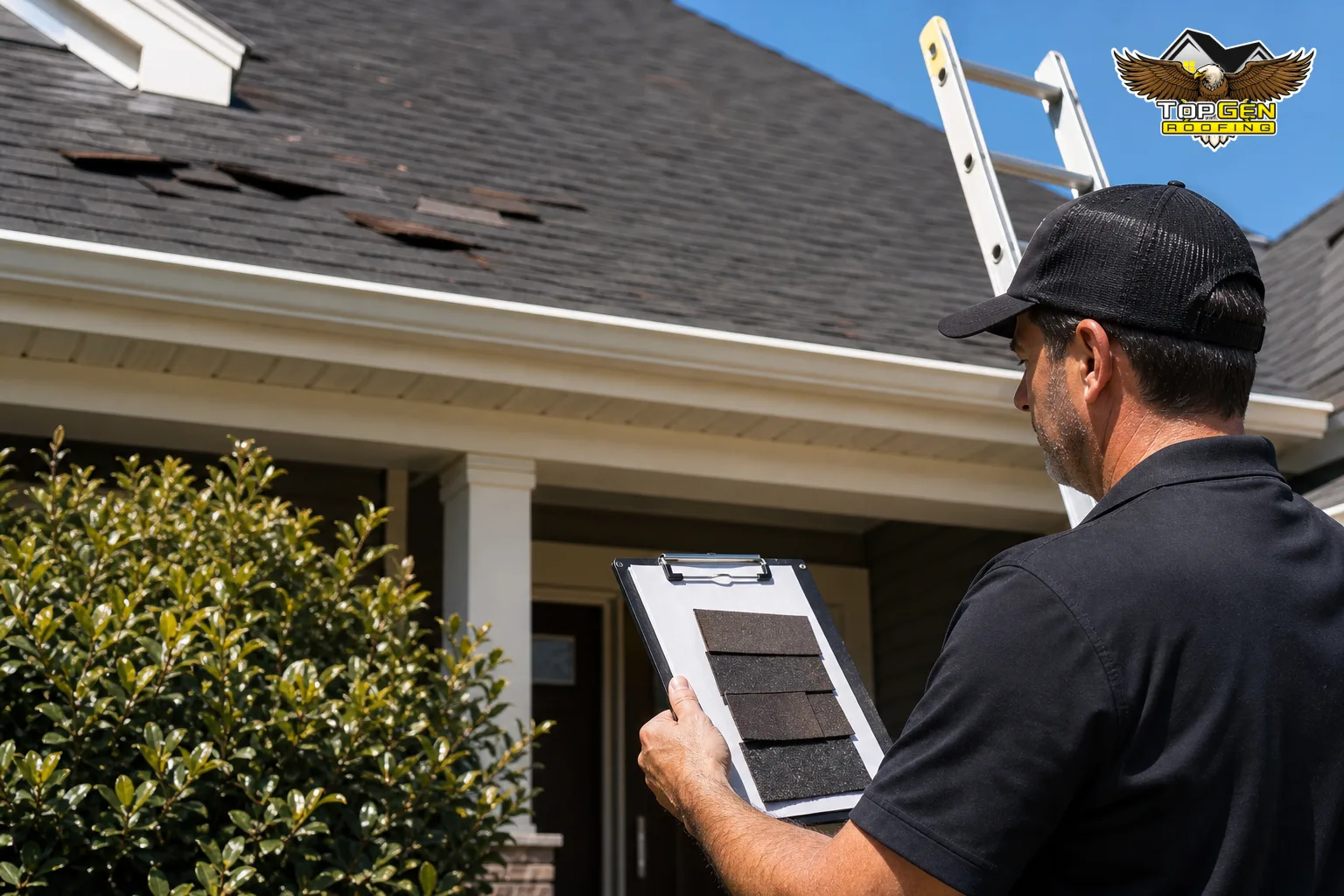
Safety first: when to call professionals vs. inspecting yourself
Do not climb onto your roof right after a storm. Wet surfaces, broken decking, and destabilized flashing create real fall hazards. Walk the perimeter from the ground and use binoculars to scan for missing shingles, lifted ridge caps, or exposed underlayment.
If you spot structural sagging, displaced chimney flashing, or large debris, call a licensed roofing contractor immediately rather than attempting any self-inspection at height.
A contractor can access the roof safely and produce a written inspection report the same day, which is exactly what your adjuster will want to see.
Temporary repairs and tarping to prevent further damage
Your policy likely requires you to take "reasonable steps" to prevent additional loss after a covered event. Failing to tarp an open section can give your insurer grounds to deny the water damage portion of your claim.
Heavy-duty polyethylene tarps should cover any exposed decking or open penetrations. Secure them with lumber, not just weights. Keep every receipt for tarping materials, labor, and emergency service calls.
These costs are typically reimbursable under your policy’s "additional living expenses" or emergency repair provisions. You can learn more about protecting your property during active roof work in this guide on how to avoid property damage during roof repair and replacement.
Taking initial photos and video evidence before cleanup
Photograph everything before you move a single shingle or piece of debris. Wide shots establish the overall scene. Close-ups capture granule loss, lifted nail strips, and cracked or curled edges.
Video walkarounds provide continuity that static photos cannot.
Use a smartphone with GPS-enabled metadata turned on so each image is timestamped and geotagged. That data becomes part of your evidence file and helps counter any insurer argument about when the damage occurred.
Document Wind Damage for Your Insurance Claim
Strong documentation is the single biggest factor separating approved wind damage roof claims from denied ones. A well-organized evidence file answers the adjuster’s questions before they ask them.
Professional roof inspection reports and what insurers require
A licensed contractor’s written inspection report should include the specific areas affected, the estimated extent of damage in square footage, the materials impacted, and a professional opinion on whether the damage is storm-related or pre-existing. Insurers give far more weight to third-party contractor findings than to homeowner-submitted photos alone.
For roofs that also sustained hail hits alongside wind, make sure the inspection separates the two damage types. Adjusters will look for that distinction. Top Gen Roofing provides detailed inspection reports specifically structured for insurance claims.
If you’re also dealing with hail, see our dedicated page on hail damage repair for what that documentation process looks like.
Creating a detailed damage inventory with measurements and dates
Build a written log that pairs each damage item with the date of the storm, the approximate location on the roof (e.g., "northeast slope, third course of shingles from ridge"), and a brief description. If you have pre-storm inspection records, maintenance receipts, or photos from a previous repair, include those too. They establish a baseline that proves the current damage is new.
Use a simple spreadsheet or the table format below to organize your inventory before submitting to your carrier.
| Damage Item | Location on Roof | Estimated Area | Date Observed | Photo Reference |
|---|---|---|---|---|
| Missing shingles | North slope | ~8 sq ft | Day of storm | IMG_0041, 0044 |
| Lifted ridge cap | Ridge, east end | 12 linear ft | Day of storm | IMG_0057, 0059 |
| Damaged flashing | Chimney base | 4 linear ft | Day +1 | IMG_0072 |
| Soffit damage | Northeast corner | 6 sq ft | Day +1 | IMG_0083 |
Gathering supporting evidence: weather reports, neighbor statements, repair quotes
Pull the official weather data for your address from the National Weather Service or a local news archive. A record confirming wind gusts above 50 mph on a specific date is powerful corroborating evidence. Neighbor statements, especially from someone whose fence or trees were also damaged in the same event, add credibility.
Get at least two written repair quotes from licensed contractors. These estimates help establish your storm damage roof repair cost before the adjuster’s own estimate comes in. If the insurer’s estimate comes in significantly lower, your contractor quotes become leverage for a supplement.
Understand Your Insurance Policy and Coverage Limits
Read your declarations page before you file. The two most consequential terms are your deductible and whether your policy pays replacement cost value (RCV) or actual cash value (ACV).

How deductibles, replacement cost, and actual cash value affect payouts
RCV policies pay the full cost to replace damaged materials at today’s prices, minus your deductible. ACV policies subtract depreciation, meaning a 15-year-old shingle roof may yield a payout significantly less than the actual repair bill. Many policies have separate wind or hurricane deductibles that are higher than the standard deductible, often expressed as a percentage of your home’s insured value rather than a flat dollar amount.
| Coverage Type | How It Pays | Impact on Claim |
|---|---|---|
| Replacement Cost Value (RCV) | Full current cost minus deductible | Higher payout, less out-of-pocket |
| Actual Cash Value (ACV) | Depreciated value minus deductible | Lower payout, more out-of-pocket |
| Wind/Hurricane Deductible | % of insured value (e.g., 1, 5%) | Can be thousands of dollars |
Common exclusions and limitations in homeowners policies
Most standard policies exclude damage caused by "gradual deterioration," poor maintenance, or materials that were already at end of life before the storm. If your shingles were 25 years old and showed significant wear before the storm hit, the insurer may argue the wind simply finished what age started. This is precisely why pre-storm inspection records matter.
According to guidance from YPA Public Adjusters, documentation collected before a storm is often the difference between full approval and a partial denial.
File Your Claim Within the Deadline
Most insurers require written notice of wind damage within one year of the event, but some state laws and policy language shorten that window considerably. Filing late is one of the most avoidable reasons claims fail.
State-specific claim filing deadlines and notification requirements
Filing deadlines vary. New York, for example, requires prompt notice under most homeowners policies, and courts have interpreted "prompt" strictly. Other states set explicit statutory windows ranging from 60 days to 2 years.
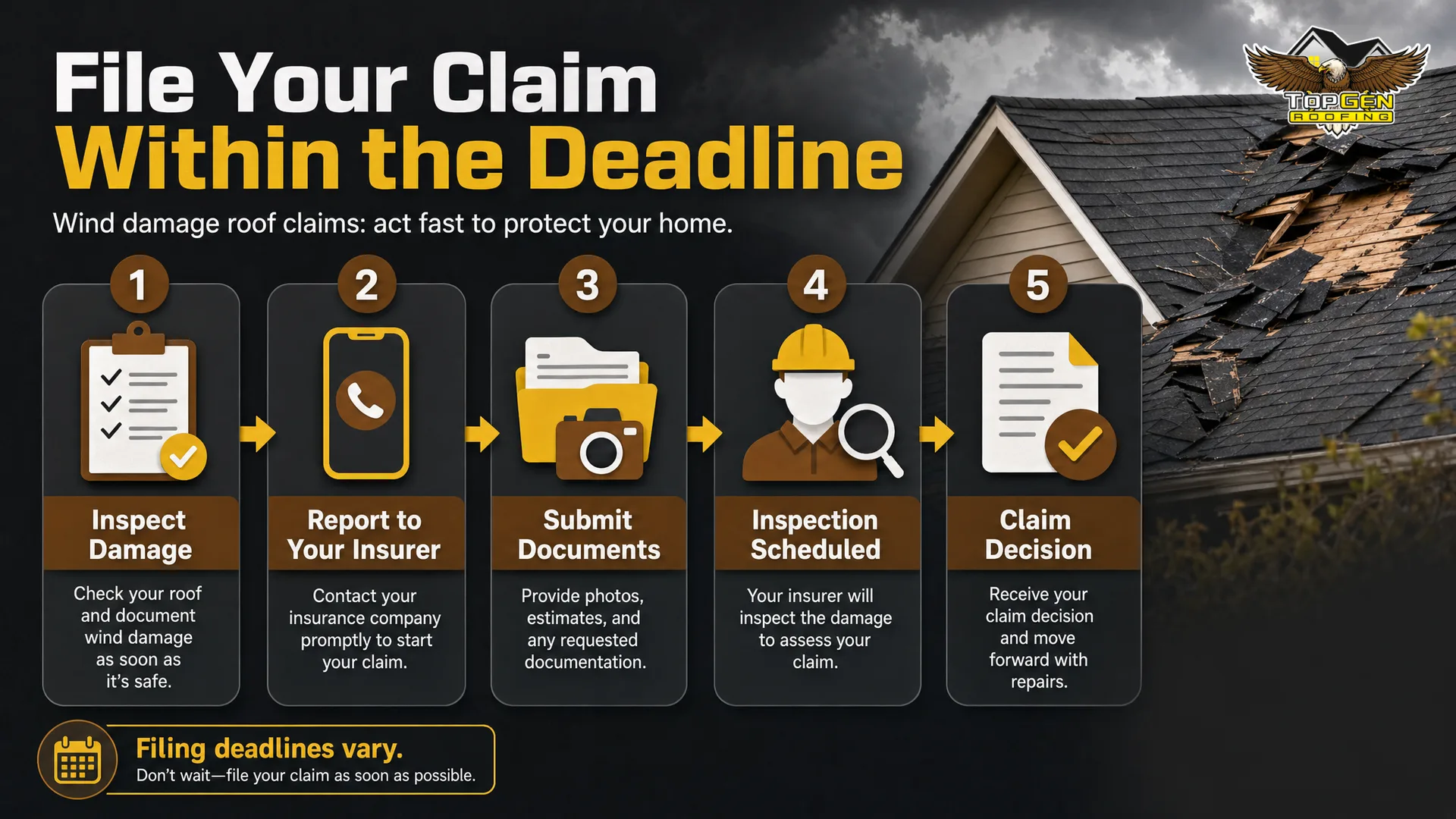
Check your specific policy language first, then confirm your state’s requirements with your state insurance department. When in doubt, file early.
Step-by-step process for submitting your claim and required forms
- Contact your insurance company by phone or online portal to open a claim and receive a claim number.
- Submit your written damage inventory, timestamped photos, weather report, and contractor inspection report.
- Provide the repair quotes from licensed contractors.
- Request written confirmation of receipt for every document you submit.
- Ask for the adjuster’s name, direct contact, and an estimated timeline for inspection.
Tracking your claim status and communicating with your adjuster
Keep a communication log: date, time, who you spoke with, and what was discussed. Send follow-up emails after phone calls to create a written record. If your adjuster misses scheduled inspection appointments or goes silent, escalate in writing to a supervisor.
Your state insurance department also has a formal complaint process that tends to accelerate slow claims.
Handle Common Reasons Claims Are Denied or Underpaid
Lack of documentation and how to avoid claim rejection
According to analysis from Wallace Insurance Law, the most frequent reason wind damage claims are denied is insufficient proof that the damage was storm-caused and not pre-existing. A single batch of post-storm photos without a contractor report, without weather data, and without a written log leaves the adjuster with too much room to question the cause.
Build your documentation file as if you expect the claim to be disputed. That mindset alone will keep most denials from happening.
Pre-existing damage and maintenance issues insurers use to deny coverage
If your gutters were clogged, shingles were already lifting, or flashing was visibly deteriorating before the storm, an adjuster may attribute post-storm leaks to maintenance neglect rather than wind. Regular roof inspections and maintenance create the records that counter this argument. For guidance on keeping your roof in claim-ready condition year-round, our article on essential roof repairs and protecting your home outlines what routine upkeep actually looks like.
If your shingles were lifted or ripped off entirely, a specialized inspection report that identifies storm-specific damage patterns can be decisive. See our resource on shingles ripping up or ripped off by wind for what those patterns look like and how contractors document them.
Next Steps: Appeals, Disputes, and Getting a Fair Settlement
A denial is not final. You have the right to challenge both the decision and the damage estimate, and exercising that right is often worth the effort.

How to appeal a denied claim or request an independent inspection
Start with a formal written appeal that responds pointby addressing each specific denial reason with counter-evidence. Reference the exact policy language the insurer cited, then attach your contractor’s inspection report, weather data, and damage inventory as exhibits. Request the insurer’s claim file under your state’s insurance regulations, you’re entitled to see the adjuster’s notes and any internal assessments.
If your policy includes an appraisal clause, you can invoke it to bring in an independent appraiser when you and the insurer disagree on the damage amount. Both sides hire their own appraiser, and a neutral umpire breaks any tie. This process is faster and cheaper than litigation and often produces fairer settlements.
When to hire a public adjuster or attorney
A public adjuster works for you, not your insurer. They assess the damage independently, prepare the claim documentation, and negotiate directly with the carrier. Their fee is typically 10 to 15 percent of the final settlement, which means they only benefit if you do.
For complex claims involving extensive structural damage or initial denials, that cost is usually well justified.
If the insurer acted in bad faith, delayed unreasonably, or denied a clearly valid claim without a credible reason, an insurance attorney is the appropriate next step. Many work on contingency for property insurance disputes, so there’s no upfront cost. For a complete look at what a roof replacement following storm damage involves, see our guide on what to expect and how to prepare for a roof replacement.
Frequently Asked Questions
How long do I have to file a wind damage roof claim?
It depends on your state and your specific policy language. Many homeowners policies require "prompt" notice, which courts in states like New York have interpreted strictly. Statutory windows in other states range from 60 days to 2 years.
The safest approach is to notify your insurer within a few days of discovering damage, even if you haven’t finished gathering all your documentation yet. According to Kin Insurance’s roof damage claim guide, filing early also gives you more time to negotiate if the initial offer is low.
What documentation do I need for a wind damage roof insurance claim?
At minimum, you need timestamped photos and video of the damage, a written damage inventory with dates and locations, an official weather report confirming wind speeds on the date of the storm, and a written inspection report from a licensed roofing contractor. Repair quotes from at least two contractors strengthen your position when the adjuster’s estimate comes in. The more organized and specific your file, the harder it is for the insurer to question the cause or extent of the damage.
Will my homeowners insurance cover the full cost of roof replacement after wind damage?
That depends on whether your policy pays replacement cost value (RCV) or actual cash value (ACV). An RCV policy covers the full current cost to replace damaged materials minus your deductible. An ACV policy subtracts depreciation, which on an older roof can significantly reduce your payout.
Some carriers also apply a separate wind deductible expressed as a percentage of your home’s insured value. Review your declarations page carefully before your adjuster visit so you understand the maximum realistic payout. For context on what full replacement involves, our page on upgrading your home with a roof replacement walks through the process in detail.
What are the most common reasons wind damage claims get denied?
The most frequent denial reasons are insufficient documentation, pre-existing deterioration or deferred maintenance, late filing, and damage attributed to gradual wear rather than a storm event. Insurers routinely argue that lifted or missing shingles were already compromised before the wind hit. As Wallace Insurance Law notes, many denials come down to the insurer’s ability to characterize damage as long-term wear rather than a sudden covered loss.
Strong pre-storm maintenance records and a detailed contractor report are your best defense.
Should I make temporary repairs before the adjuster inspects my roof?
Yes, and your policy likely requires it. Most homeowners policies include a duty to mitigate further damage, meaning you must take reasonable steps to prevent additional loss after the storm. Tarping exposed decking, covering broken skylights, and securing loose flashing all fall under this obligation.
Keep every receipt and photograph the temporary repairs before and after. Do not make permanent repairs until the adjuster has completed their inspection, or you risk losing the ability to document the original damage accurately. According to guidance from Ridgeline Roofing, acting within the first 24 hours to protect the structure is one of the most important steps you can take after a severe storm.
How does storm damage roof repair cost factor into my insurance settlement?
Your storm damage roof repair cost is established through the contractor quotes and material specifications you submit with your claim. The insurer’s adjuster will produce their own estimate, which may be lower. If there’s a significant gap, your contractor quotes and the adjuster’s estimate become the starting point for negotiation.
Supplements, additional amounts requested after the initial estimate, are common when adjusters miss line items or underestimate material costs. Getting quotes from licensed local contractors familiar with current Saratoga Springs area pricing gives you accurate numbers to reference throughout the process.
 FREE estimate within 24 hours Share a few details with Top Gen Roofing, we’ll help you choose the right next step. Get a free estimate |